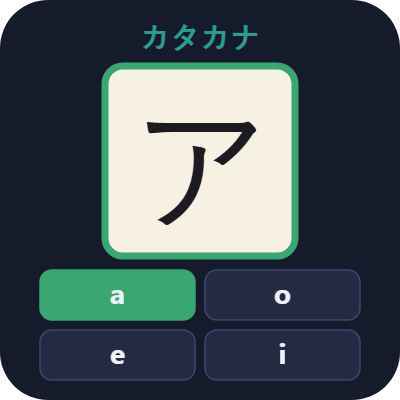
Katakana
katakana game
Learn katakana by playing: the 46 basic characters, the voiced ones and combinations like キャ and ショ, 104 in all, a row at a time. 60-second rounds in three ways: choose the reading, type it, or find the right character among the ones that look alike, like シ and ツ. With pronunciation, where your device has a Japanese voice.
Play KatakanaHow to play
Three ways to play, chosen with the button at the top: Choose (a character and four readings), Type (a character, and you type how it reads) and Reverse (a reading and four characters, among the ones people really confuse). Each round lasts 60 seconds: a right answer is worth 10 points, times your streak of right answers in a row (×2 after five, up to ×5); a mistake resets the streak and shows the right answer. You start with the vowels, and once every character of the new row has been answered right twice, the next row joins in: fifteen levels, from the vowels to combinations like kya and sho. The Level button chooses where to start. When typing, shi and si both count, as do tsu and tu, and fu and hu. With Voice: on, your phone or computer pronounces each character, if it has a Japanese voice; tap the character to hear it any time. Keyboard: 1–4 pick an answer, letters type, Space plays the sound, Enter starts, Esc starts again.
How it works
Katakana teaches you katakana by playing, one character at a time. Each round lasts 60 seconds: a question appears, you answer, and the next one comes straight away. There are 104 characters: the 46 basic ones, the 25 with the voicing marks (゛ and ゜) and the 33 combinations with a small ャ, ュ or ョ, such as キャ and ショ.
You start with the five vowels. Once every character of the new row has had two right answers, the next row joins in and the game tells you so: fifteen levels, from the vowels to the combinations. Questions come from every row you already know, the newest one more often, and the characters you got wrong come back until you get them right. The Level button chooses where to start, if you already know the first rows.
Three ways to play
- Choose: a character and four readings; tap the right one. The wrong readings are the ones people really mix up: with シ you also get chi, tsu and su.
- Type: a character, and you type how it reads. There is no Enter to press: the answer counts the moment it is complete. Every correct spelling counts — shi and si, tsu and tu, fu and hu, ji and zi. On a phone, tap the screen to open the keyboard.
- Reverse: a reading and four characters; find the right one. Here the wrong answers are the shapes that look alike, such as シ and ツ, ソ and ン, ク and ケ.
Scoring
- 10 points for each right answer.
- Your streak multiplies them: from five right answers in a row they are worth double, from ten triple, up to five times.
- A mistake resets the streak and shows you the right answer, which stays on screen for a moment while the clock keeps running.
- At the end of the round you see your score, right and wrong answers, your longest streak and the characters to review. There is a record for each way of playing.
Pronunciation
With Voice: on, your phone or computer pronounces each character after you answer, and tapping the character plays it any time. The game uses your device's own Japanese voice, and only one installed on the device itself; if there is none, the button does not appear. iPhones and Macs always have one; on Windows and Android you can add one in the language or text-to-speech settings.
The katakana charts
The basic characters, row by row: the first column is the consonant, the others the vowel.
| a | i | u | e | o | |
|---|---|---|---|---|---|
| – | ア a | イ i | ウ u | エ e | オ o |
| k | カ ka | キ ki | ク ku | ケ ke | コ ko |
| s | サ sa | シ shi | ス su | セ se | ソ so |
| t | タ ta | チ chi | ツ tsu | テ te | ト to |
| n | ナ na | ニ ni | ヌ nu | ネ ne | ノ no |
| h | ハ ha | ヒ hi | フ fu | ヘ he | ホ ho |
| m | マ ma | ミ mi | ム mu | メ me | モ mo |
| y | ヤ ya | ユ yu | ヨ yo | ||
| r | ラ ra | リ ri | ル ru | レ re | ロ ro |
| w | ワ wa | ヲ wo | |||
| n | ン n |
With the voicing marks. The ゛ mark voices the consonant (k becomes g, s becomes z, t becomes d, h becomes b), and the small circle ゜ turns h into p. ジ and ヂ are both read ji, ズ and ヅ both zu: modern writing almost always uses ジ and ズ. The game never offers them side by side as answers.
| a | i | u | e | o | |
|---|---|---|---|---|---|
| g | ガ ga | ギ gi | グ gu | ゲ ge | ゴ go |
| z | ザ za | ジ ji | ズ zu | ゼ ze | ゾ zo |
| d | ダ da | ヂ ji | ヅ zu | デ de | ド do |
| b | バ ba | ビ bi | ブ bu | ベ be | ボ bo |
| p | パ pa | ピ pi | プ pu | ペ pe | ポ po |
The combinations. A character from the i column followed by a small ャ, ュ or ョ is read as one syllable: キ + ャ = キャ.
| ya | yu | yo | |
|---|---|---|---|
| ky | キャ kya | キュ kyu | キョ kyo |
| sh | シャ sha | シュ shu | ショ sho |
| ch | チャ cha | チュ chu | チョ cho |
| ny | ニャ nya | ニュ nyu | ニョ nyo |
| hy | ヒャ hya | ヒュ hyu | ヒョ hyo |
| my | ミャ mya | ミュ myu | ミョ myo |
| ry | リャ rya | リュ ryu | リョ ryo |
| gy | ギャ gya | ギュ gyu | ギョ gyo |
| j | ジャ ja | ジュ ju | ジョ jo |
| by | ビャ bya | ビュ byu | ビョ byo |
| py | ピャ pya | ピュ pyu | ピョ pyo |
Strategy that actually helps
One row at a time. Learning the five vowels well before moving on to the k row works better than seeing every character at once. The game is built that way: the new row only joins once the one before it is secure.
Mix the modes. Choose trains recognition, Type recall with no help, Reverse telling shapes apart. Playing only Choose ends in guessing by elimination.
Watch the difficult pairs. シ and ツ: in シ the short strokes are on the left and the long one rises from below, in ツ the short strokes sit on top and the long one falls. ソ and ン work the same way. ク, ケ and タ differ by one stroke; ウ and ワ by the dash on top; コ and ユ by the bottom line.
Say it out loud. Reading the character as you answer, or turning the voice on, ties the shape to the sound, which is what reading actually needs.
A little history
Katakana began in the ninth century in Japanese Buddhist monasteries: monks annotated Chinese texts with pieces of kanji, taken for their sound, and those fragments became a script. That is why its shapes are straight and angular. Today katakana writes words borrowed from other languages, such as コーヒー (coffee) or テレビ (television), foreign names, animal sounds, and words set apart for emphasis, the way italics are in English.
If you like it, try Hiragana too, and Kanji Quiz for the next step.
Common questions
Is it free? Yes. It runs in your browser, with no signup and nothing to download.
Do I need to know any Japanese already? No. You start with the five vowels and the game adds one row at a time.
How many characters are there? 104: the 46 basic ones, 25 with the voicing marks and 33 combinations.
Which romanisation does it use? Hepburn, the one in textbooks and on signs (shi, chi, tsu, fu, ji). When typing, si, ti, tu, hu and zi count too.
Why is there no pronunciation? Your device has no Japanese voice installed. The game only uses voices that run on the device, without sending anything over the network.
Can I play on a phone? Yes, in all three modes. To type, tap the screen and the keyboard opens.
More games
Also available in: Italiano