Pool
billiards game
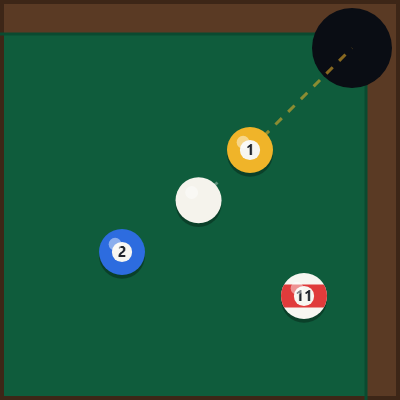
Pool seen from above, on your own against the table: fifteen balls to pot before the shots run out. Pull back from the cue ball and let go, like a catapult, and the aim line shows you what it will hit. Every table you clear opens another one, with one shot fewer to do it in.
Play PoolHow to play
The goal is to pot every ball before you run out of shots. Touch near the cue ball and drag backwards: the direction is the opposite of your drag and the power is how far back you pull; let go and the cue strikes. The dashed line shows where the cue ball arrives and the circle where it will touch, the yellow line where the ball it hits will set off. A potted ball is worth 100 points, and each extra ball in the same shot is worth 100 more. Potting the cue ball costs 50 points and puts it back on the line. Clearing the table pays 100 points for every shot you did not use and opens the next table, which gives you two shots fewer, down to a floor of twelve. When the shots run out the game may offer four more in exchange for a video, once per table. Keyboard: left and right arrows aim (hold Shift for finer), up and down arrows set the power, Space shoots, P pauses, N starts a new game.
How it works
A pool table seen from above, fifteen numbered balls and a white cue ball. You play on your own against the table: pot every ball before your shots run out. There is no opponent to wait for, no solids and stripes to be assigned and no black ball to leave until last — the table is the whole opponent, and the only question is how few shots you need.
Each table you clear opens another one, with two shots fewer than the last, down to a floor of twelve. So the game does not end when you play badly; it ends when the table finally asks for more than you can give it.
The shot, which is one gesture
Touch anywhere near the white ball and drag backwards, the way you pull a catapult. Two things happen at once, which is the point:
- the direction is the opposite of your drag — pull down and to the right, and the ball sets off up and to the left;
- the power is how far back you pull. The gap between the tip of the cue and the ball is the power made visible, so you never have to read a bar to know how hard you are about to hit.
Let go and the cue strikes. Drag only a little and let go, and nothing is wasted: a pull shorter than a fingertip cancels the shot.
What the aim lines tell you
While you are aiming, the table shows you the three things a player at a real table works out by eye:
- the dashed white line — where the cue ball travels, right up to the first thing in its way;
- the pale circle — where the cue ball will be at the moment it touches. This is the ghost ball, and aiming the circle at the ball rather than aiming the line at the pocket is the single biggest thing that improves a beginner;
- the yellow line — the direction the ball you hit will set off in.
The lines stop at the first contact, cushion included, because a prediction of what happens after two collisions would be a guess dressed as a promise.
Controls
- Touch or mouse: drag back from the cue ball, let go to shoot.
- Keyboard: left and right arrows aim, and holding Shift aims finer; up and down arrows set the power; Space shoots; P pauses; N starts a new game.
The table turns with your screen. On a phone it stands up, on a computer it lies down, and it is the same table either way — so the same shot is the same shot, whichever device you are on.
Scoring
| A ball potted | 100 points |
| Each extra ball in the same shot | 100 points more each |
| Clearing the table | 100 points for every shot you did not use |
| Potting the cue ball | −50 points, and it goes back on the line |
Two balls in one shot are therefore worth 300, not 200, and three are worth 500. That is the only place in the game where luck pays — and it pays enough to be worth aiming for when two balls line up on the same pocket.
Potting the white ball is called a scratch. It costs you the points and the shot, and the cue ball comes back to the head line, where it started.
When you run out of shots with balls still on the table, the game may offer you four more in exchange for watching a video — once per table. Saying no ends the run exactly as it would have ended anyway.
How to actually get better
Aim the ghost, not the ball. A beginner points the cue at the ball and wonders why it goes wide. The ball leaves along the line between its centre and the point where the cue ball touched it, so what you are really aiming is that contact point — which is what the pale circle is showing you.
Take the straight pot. A ball straight in front of a pocket goes in from almost any speed. A ball at a thin angle needs the contact point to be right within a millimetre. When two pots are on, the straighter one is almost always the better one, even if it is worth the same.
Hit softer than you think. Power is for breaking and for long tables. Close to a pocket, a hard shot rattles the jaws and comes out; a soft one drops. It also leaves the cue ball nearer to where you left it, which is the beginning of thinking about your next shot.
Watch where the white ball ends up. You have a fixed number of shots, so a pot that leaves the cue ball stuck behind a cluster has cost you the next one. Professionals call this position play; here it is simply the difference between clearing a table and running out.
Frequently asked questions
Is there an opponent? No. It is you and the table, which is the version of pool you can start and finish in two minutes.
Can I put spin on the ball? Not in this version. The cue ball is always struck in the centre, which keeps the table honest: everything that happens is something you could have predicted by looking.
Why do my shots run out? They are the score. Anyone can clear a table with unlimited shots; the game is doing it in twenty, then eighteen, then sixteen.
Does it work on a phone? Yes, and the table stands up to use the whole screen. Drag from anywhere near the white ball — you do not have to touch the ball itself, so your finger never covers what you are aiming at.
More games

Also available in: Italiano