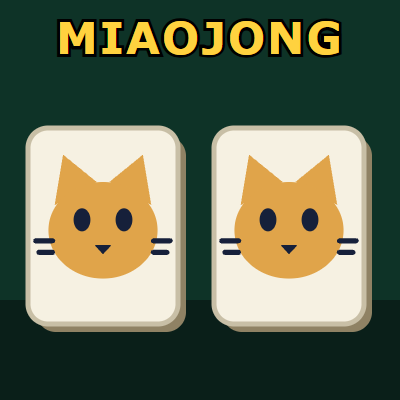
Miaojong
mahjong solitaire
Mahjong solitaire with kittens, and with a promise most solitaires cannot make: the board is dealt backwards, lifting pairs off an empty stack instead of shuffling at random, so a solution always exists — after a reshuffle too. What is left to avoid is not bad luck but bad choices: taking the wrong pair can bury the one you needed. A hundred and forty-four tiles in the turtle layout, three tile styles you can switch mid-game, and a score that pays more to the player who spots a pair quickly than to the one who finds it late.
Play MiaojongHow to play
The goal is to empty the board by removing matching pairs. A tile can only be taken when it is free: nothing resting on top of it, and at least one of its two sides — left or right — clear. Blocked tiles are shown behind a veil. Flowers match any other flower and seasons match any other season even when the drawing differs; every other tile wants its exact twin. Scoring: each pair is worth a hundred points plus a speed bonus of up to a hundred more, full below two seconds since your last move and fading to nothing by ten. Emptying a board pays two thousand points plus five hundred per level, capped at the tenth. A hint shows you one pair and costs fifty points; undo puts a pair back and takes away the points it earned. Reshuffles: three per game, not per board — spend two on the first board and you reach the second with one. They redeal the remaining tiles and always leave the game solvable. The game ends when no pair is available and no reshuffle is left; clearing a board moves you to the next one. Your best score stays on the device. Controls: tap two matching free tiles to clear them; two fingers zoom, one finger pans, a double tap fits the board back on screen, and a mouse wheel zooms. On a keyboard: H hint, U undo, S shuffle, M sound, T tile style, P or Esc pause, Enter resumes. The in-game interface is in English.
The rules, in full
The 144 tiles are stacked in five layers in the classic turtle shape: 87 on the bottom, then 36, 16 and 4, with a single tile on top. There is one wing tile at the left end of the middle rows and two at the right. The goal is to clear the whole board, two tiles at a time.
- A pair is two identical tiles. Tap one, then the other, and both disappear.
- Only free tiles can be taken. A tile is free when nothing lies on top of it and at least one of its sides, left or right, is clear. Blocked tiles are shaded, so you can still read them while you plan.
- Flowers and seasons are the exception. Any flower matches any other flower, and any season any other season, even though the pictures differ.
- The deck is the traditional one: three suits numbered 1 to 9, four winds and three dragons, four of each, plus four flowers and four seasons.
Every deal can be solved. The board is built backwards, pair by pair, always placing a pair on two positions that would be free at that point, so at least one complete solution exists from the first move. That does not make every line of play safe: with four copies of a tile, pairing the wrong two can still leave you stuck.
Scoring
- 100 points for every pair, plus a speed bonus of up to 100 more. The full bonus is yours if you clear the pair within two seconds of your previous move, and it shrinks to nothing at ten seconds.
- 50 points taken off each time you ask for a hint.
- A bonus for clearing the board: 2,000 points plus 500 per level, up to level
The score never drops below zero, and your best is kept in the browser.
Hint, undo, shuffle and levels
Hint (H) lights up one pair you can take right now, for 50 points. Undo (U) puts the last pair back and takes its points off again, as many times as you like. Shuffle (S) deals the remaining tiles into the same positions again, using the same backwards method, so the new layout is still solvable. You get three shuffles for the whole game, not for each board, and a shuffle wipes the undo history.
When the board is cleared you move on to the next level: a fresh turtle, with your score carried over and whatever shuffles you have left. If no pair is left while you still have shuffles, the game tells you to shuffle. It ends only when no pair is left and all three are spent.
Strategy that actually helps
Free the tiles that block the most. The single tile on top covers four, and the wing tiles at each end block the long middle rows. Opening those early gives you far more choices later.
When all four copies are free, take both pairs. Nothing can go wrong. When only three are free, pick the pair whose removal frees the most new tiles, or leaves the third one where it does not block anything.
Undo before you shuffle. Undo is unlimited and only takes back the points of the pairs it returns. A shuffle is limited and erases every step you could have taken back, so try another line first.
Use the speed bonus, not the hint. A quick pair can earn 200 points, a hint costs 50. Hints are for when you are truly stuck.
Save your shuffles for the later boards. They have to last the whole game: two spent on the first board leave one for every board after it.
Play carefully once the shuffles are gone. From then on the game ends the moment no pair is left, and undo cannot bring it back.
Try the numbers style on a small screen. Every kind of tile gets its own number, and all flowers share one number, as do all seasons.
A little history
The tiles come from mahjong, the four-player game that took shape in China in the nineteenth century and spread around the world in the twentieth. The solitaire, where one player clears pairs from a stacked layout, is much younger. It is usually traced to computer games of the early 1980s, and the turtle is still its best-known layout. Stories that give it an ancient origin are common, but nothing seems to support them.
Common questions
Is it free? Yes. It runs in your browser, with no signup and nothing to download.
Does it work on a phone? Yes. Tap tiles to select them, pinch with two fingers to zoom and drag with one to move the board, and double tap to switch between a close view and the whole board. It works in portrait and landscape.
Can I change how the tiles look? Yes. There are three styles, kittens, classic and numbers, and the tiles button or T switches between them at any time, even mid-game. The rules stay exactly the same.
Can I install it? Yes. Bananai can be installed as an app from the browser, and a game you have already opened usually keeps working when the connection drops.
More games
Also available in: Italiano