Mini Golf
18-hole mini golf game
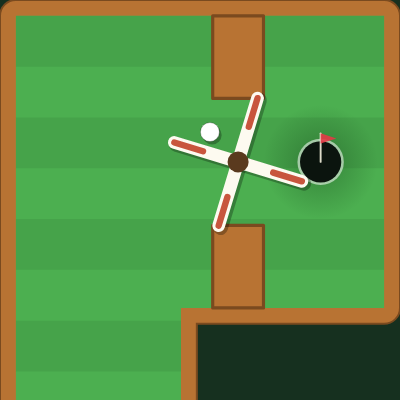
Mini golf over 18 holes seen from above: pull back and let go to putt, then watch the ball bank off the walls. Doglegs, posts, sand, a hill, a bridge over water, a tunnel, turning mills and a sliding gate. Every hole has its par, and the round ends with your scorecard.
Play Mini GolfHow to play
Touch or mouse: drag anywhere on the course, away from where you want the ball to go, and let go; the longer the drag, the harder the putt. The arrow shows direction and power. Keyboard: left and right aim (hold Shift for fine aim), up and down set the power, space putts. C shows the scorecard, N starts again. Water costs a stroke and the ball comes back to where it was played from; after six strokes the ball is picked up and the hole scores seven.
The rules, in full
Mini golf is golf reduced to the putt: a short lane of carpet with a wall all round it, a tee at one end, a cup at the other, and something in between that makes the straight line the wrong one. Here the course is seen from above and has eighteen holes, played in order.
- Get the ball into the cup in as few strokes as you can. Each stroke counts one.
- Every hole has a par, the number of strokes a good player needs. The course is a par 45: 21 on the way out, 24 on the way back.
- Water costs a stroke. A ball in the water comes back to where it was played from, and one stroke of penalty is added.
- Six strokes and the ball is picked up. If it is still out after six, the hole scores seven and you move on, the rule most courses print on their cards so that nobody is stuck on one hole all afternoon.
- The ball drops only if it arrives slowly enough. A ball that crosses the cup too fast jumps the hole or curls round the rim and out, as it does on a real green.
At the end of the eighteenth hole you get your card: strokes hole by hole, the total, and how far it is from par.
How to putt
Drag back from where you want the ball to go, anywhere on the course, and let go. The stroke goes the opposite way to your drag, as a catapult does, and the longer the drag, the harder the putt. While you drag an arrow shows the direction and the power, green for a soft touch, yellow for a firm one and red for the hardest.
You do not need to start on the ball: on a phone the ball is small and a finger is not, so a drag begun anywhere works the same.
The eighteen holes
- The Straight (par 2). A clear lane to learn how far the ball rolls.
- Dogleg (par 2). The lane turns right at the top. Play it off the far wall, or in two round the corner.
- The Pins (par 2). Four posts in a diamond across the straight line. There is a gap between each pair.
- The Block (par 3). A block in the middle of the lane. Go round it, or bank off a side wall.
- The Bunker (par 2). Sand across the middle, with a lane down each side. A ball in the sand stops quickly.
- The Hill (par 2). A ramp up to the cup. Too soft and the ball rolls back down to your feet.
- The Mill (par 3). The only gap in the wall is swept by turning sails. Wait for the opening.
- The Bridge (par 3). Water across the lane and a bridge off to one side.
- The Bowl (par 2). The cup sits in a hollow that draws the ball in, fenced by five posts.
- Zigzag (par 3). Past the first wall on the right, past the second on the left.
- Bumpers (par 2). Four rubber rings that kick the ball back harder than it arrived.
- The Tunnel (par 2). A wall right across the lane, and a tunnel under it that comes out on the far side.
- The Gate (par 3). A gate slides back and forth across the gap.
- The S-Bend (par 3). Up, across and up again, with sand in the corner.
- The Moat (par 3). The cup on an island, one bridge, and a post in the way of the straight shot.
- Twin Mills (par 3). Two mills, turning opposite ways.
- The Break (par 2). The whole green leans to the right. Aim up the slope and let it bend back.
- The Finale (par 3). Uphill, round the corner, past the mill and into the bowl.
The words on the card
- Hole in one: the ball in with the first stroke.
- Birdie: one under par. Eagle: two under. Albatross: three under.
- Par: exactly par.
- Bogey: one over par. Double bogey: two over.
Strategy that actually helps
Judge the distance before the line. On a short course a ball on the right line that is too fast lips out, and one that is too slow stops short. Most strokes are lost on power, not on aim.
Use the walls. The walls are part of the game. A bank shot off a wall reaches a cup that the straight line cannot, and on a dogleg it is often the only way in one.
Leave yourself an easy second. When the hole in one is a long gamble, putt to a spot with a clear line to the cup instead of to the cup itself.
Watch the mill, not the ball. The sails turn at a steady speed. Count a couple of turns, then putt as a gap is opening, not as it closes.
Aim up the slope. On a sloping green the ball bends downhill as it slows, so aim above the cup and let the slope bring it back.
Controls
- Touch or mouse: drag back anywhere on the course and let go.
- Keyboard: left and right aim (hold Shift for fine aim), up and down set the power, space putts. C shows the card, N starts a new round.
A little history
Putting on its own is older than it looks. In 1867 the Ladies' Putting Club of St Andrews, in Scotland, was founded so that women could play on a short course of their own. The game with obstacles came from the United States in the 1920s, where miniature courses spread by the thousand. In Europe it took its standard form in the 1950s, when the Swiss designer Paul Bongni drew a set of holes that could be built the same everywhere. That is the minigolf of seaside towns and campsites. The British call it crazy golf, and courses with waterfalls and caves are often sold as adventure golf. If you like games about aiming, try Pool or Darts too.
Common questions
Is it free? Yes. It runs in your browser, with no signup and nothing to download.
How many holes are there? Eighteen, played in order, par 45.
Does it keep my best round? Yes, on the device you play on.
What happens in the water? The ball comes back to where you played it from, and you take one stroke of penalty.
Why did my ball go over the cup? It was too fast. Over the cup the ball drops only if it arrives slowly enough.
Can I play on a phone? Yes. Drag anywhere on the course to putt. On a screen wider than tall the hole turns on its side so that it is drawn bigger.
More games
Also available in: Italiano