Chess Tutor
chess with a tutor
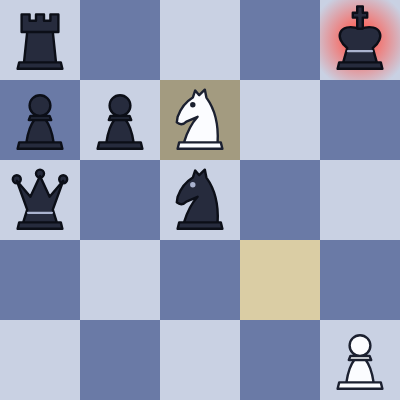
The chess that explains why a move is good. Chess against the computer, with every rule of the real game: castling, en passant, promotion to the piece of your choice, checkmate, stalemate, and draws by repetition and by the fifty-move rule. Three levels — Easy blunders on purpose, Medium punishes your slips, Hard thinks longer and gives nothing away — and you can play White or Black. Move a piece by tapping it and then its destination, or drag it across; legal moves light up, the last move stays marked, and a king in check glows red. If you get stuck you can ask for a hint or take a move back, at a small cost in points. An optional tutor recognises the most common openings — Italian, Ruy Lopez, Sicilian, French, Queen's Gambit and the rest — explains their idea, recommends a move with the reason, and rates yours: excellent, inaccuracy or mistake.
Play Chess TutorHow to play
The goal is to checkmate the computer's king. You start from New game, where you pick a level (Easy, Medium, Hard) and a colour; White moves first. Evaluation bar: to the left of the board a half-white, half-black bar shows who is better. If the white part grows White is ahead, if it shrinks Black is; the yellow mark in the middle is equality, the number is the advantage in pawns and the hash sign a forced mate. The bar is the computer's estimate and costs no points. To move, tap a piece to see its legal moves — a dot on empty squares, a ring on squares where you would capture — then tap the square you want; or drag the piece there. When a pawn reaches the last rank you choose what it becomes. Castle by moving the king two squares; en passant is offered whenever it is legal. The game ends in checkmate, in stalemate, when the same position appears for the third time, after fifty moves with no capture or pawn move, or when neither side has enough material left to mate. Scoring: a win is worth 1000 points, a draw 300 and a loss nothing; a win or a draw adds 10 points for every point of material you still have (pawn 1, knight and bishop 3, rook 5, queen 9, up to 39), and the total is multiplied by the level — 1 for Easy, 2 for Medium, 3 for Hard. Every hint and every move taken back costs 50 points. If the tutor is switched on during a game the score is halved (rounded), even if you only look at its advice for one turn. The maximum is 4170, earned by winning on Hard without losing a piece and without help. Your best score stays on the device. Tutor: the Tutor button (or the T key) shows under the board the name and idea of the opening being played, the recommended move with an arrow and the reason, the book moves available, the pieces you risk losing and, after each of your moves, a verdict: excellent, good, inaccuracy, mistake. With the tutor on the Hint button is not needed and switches off. Controls: tap or drag with a finger or the mouse; on a keyboard the arrow keys move the cursor, Enter or Space pick a piece and a square, N opens a new game, U takes back your last move together with the computer's reply, H asks for a hint, T switches the tutor on or off, F flips the board, P pauses and Esc clears the selection.
More games
Also available in: Italiano