Tycoon
property trading board game
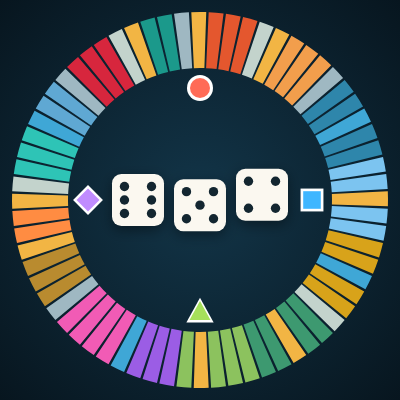
A trip round the world against computer players: buy cities, complete regions, build, trade and drive your rivals bankrupt. Or play it the other way round and be the first to lose everything. Three dice, auctions, historic routes, natural disasters, and a game that ends when you said it would.
Play TycoonHow to play
Touch or mouse: drag to turn the ring, pinch or use the wheel to zoom from the cards to the whole world, tap a space to see it, tap the buttons at the bottom to play. Keyboard: Space or Enter does the main action, the up and down arrows turn the ring, + and − zoom, R shows the whole ring.
How to play
Tycoon is a property trading board game: you against one, two or three computer players, on a ring of 68 spaces that goes round the world eastwards. Everyone starts with 1,500 in cash. On your turn you roll three dice and move that many spaces; passing Start pays you 200.
On the ring you will find:
- 48 cities in 15 regions, from North America to Oceania, by way of Europe, Africa, the Gulf and Asia. Each region has its own colour.
- Four historic routes: the Atlantic route, the Silk Road, the Trans-Siberian and the Pacific route.
- Four resources: Undersea Cables, the Power Grid, the Oil Company and Renewable Energy.
- Eight card spaces, where you draw from the News from the world and Markets decks.
- Start, the Layover, the Border and Customs.
Buying, and auctions
Land on a city, route or resource nobody owns and you may buy it at its price. If you don't, it goes to auction among the other players, and the bidding opens at the full price. Whoever declined does not bid: you cannot let a city go only to pick it up for less.
Rent, houses and hotels
A player who lands on a rival's space pays rent. The rules that matter:
- A complete region doubles the rent of each of its cities, even with nothing built.
- With a complete region you can build houses, evenly: no city may have two houses more than another in the same region. After four houses comes the hotel, which earns most of all.
- Houses and hotels are limited: the bank has 70 and 26. When they run out, nobody builds until somebody sells.
- A historic route earns more the more routes its owner holds.
- A resource charges the dice total times a number that grows with each resource its owner holds.
Cards and natural disasters
Tycoon's cards are there to move the game along, not to fill it. Besides money in, money out and moves, some cards change the table:
- Merger: buy a rival's city at its price, and they cannot refuse.
- Forced swap: swap one of your cities for a rival's of a similar price.
- Tourism boom: the rents of a region you choose double until your next turn.
- Market crash: everyone pays part of their cash to the bank.
- Wealth tax: pay part of everything you own.
- Direct flight: go to any space you like.
- Diplomatic pass: keep it, and it gets you out of Customs.
Six cards are natural disasters: earthquake, typhoon, tsunami, flood, wildfire and volcanic eruption. A disaster strikes only a region with at least one building, and its owner pays the repairs: 50 for each house and 200 for each hotel. With nothing built, the card passes harmlessly. No card names a real event and no disaster has victims: the effects are economic only.
Tap the decks at the top left to read every card drawn since the deck was shuffled, and how many are left.
Customs
Three equal dice, or the Border space, send you to Customs. To leave you roll a pair, pay the fine or use the Diplomatic pass. After two failed rolls you pay and move on.
Trading
A trade can mix cities and cash in either direction: give two cities and get one city plus money, for instance. On your turn press Trade, before or after the roll, or tap a rival's name. When a rival offers you a trade you see:
- two columns, You give and You get, with each city's price, rent and buildings;
- which regions the trade completes or breaks, for you and for them;
- the rent you collect in those regions before and after.
You can accept, refuse, answer with a counter-offer, or press See on the ring to look at where the cities in play are before deciding. When a computer player refuses your offer it tells you why and, if more cash would change its mind, how much.
Short of cash
If you owe more than you have, you can sell buildings back to the bank or mortgage cities. A mortgaged city collects no rent until you redeem it. If that is still not enough, you go bankrupt and what you own passes to the player you owed, or back to the bank.
How long a game lasts
You choose the length at the start, and it is always shown at the top, as "Round 23 of 40":
- Short: 25 rounds.
- Medium: 40 rounds.
- Long: 60 rounds.
- Open: no limit, until one player is left.
When the last round ends, the player with the highest net worth wins: cash, cities and buildings. A bankruptcy can end the game sooner.
The other way round: first to go bankrupt wins
At the start you can choose to win by going bankrupt first. The rules change in this mode:
- Start pays nothing.
- You go bankrupt as soon as your cash does not cover a payment, with no need to sell or mortgage first.
- Once a turn you may give a city away to a rival, who cannot refuse it.
Here spending pays: buy dear cities, build, give away whatever earns you rent, and land on the others' spaces. If nobody has gone bankrupt when the game ends, the lowest net worth wins.
The opponents
Each computer player has a character: the Aggressive one buys and builds everything, the Cautious one keeps cash aside, the Collector chases complete regions, the Erratic one skips purchases at random, the Newbie turns down dear cities, and the Strategist is the strongest. The Strategist plays for rent, not for property: it values a region by what it will earn before the end, pays well for the city it lacks, and never sells a rival a region for less than that region will earn them. It is also the one that will offer you the most trades.
A few tips
- Complete regions are everything. A lone city earns little; a complete region doubles the rent and opens the way to houses. A trade that completes a region for you is often worth more than it costs.
- Three houses is the sweet spot. That is where the rent makes its biggest jump against what you spend.
- Watch the clock. In a 25-round game a region bought late has no time to pay for itself.
- Mind the houses running out. With 70 houses for 48 cities, whoever builds first can leave the others without.
- Before accepting, look at the ring. A trade that hands you two cities may complete a rival's region right where you pass most often.
Following the game
The game starts at Slow speed, for anyone playing it for the first time, and the speed button changes it: slow, normal, fast, very fast or instant. What concerns you (a rent, your own card, an offer) always waits for your tap. The History shows each turn as cause and effect, and the last sixteen turns can be played again on the ring.
Drag the ring to turn it, and zoom with two fingers, the mouse wheel or the
- and - buttons: close in you see the cities' cards, further out the regions and who owns them. Tap any space to read its details.
A little history
Property trading games played round a repeating track began in 1904, when Lizzie Magie patented The Landlord's Game in the United States: she meant to show how rents enrich those who own the land at the expense of those who cross it. The genre has had many versions since. Tycoon takes up the idea with three dice, a trip round the world, auctions, trades and a game that ends when you said it would.
Common questions
Is it free? Yes. It runs in your browser, with no signup and nothing to download.
Is it like Monopoly? Yes, it belongs to the same genre: a repeating track, cities to buy, rent and houses. But Tycoon has rules, a board and cards of its own: three dice, a trip round the world, auctions at the full price, trades of cities and cash, natural disasters, a length chosen at the start and a mode where the first to go bankrupt wins. Monopoly is a trademark of Hasbro, and Tycoon has no connection with Hasbro or its game.
Does it work on a phone? Yes, in portrait and landscape.
Can I play against a friend? No: in Tycoon you always play against the computer, one to three opponents.
If I close the page, do I lose the game? No. The game is saved at every move, and when you come back you find it exactly where it was.
Why can't I build on this city? To build you must own the whole region, with no city in it mortgaged, and build evenly. If the bank has run out of houses, you wait until somebody sells one. The city's sheet always tells you why.
More games

Also available in: Italiano