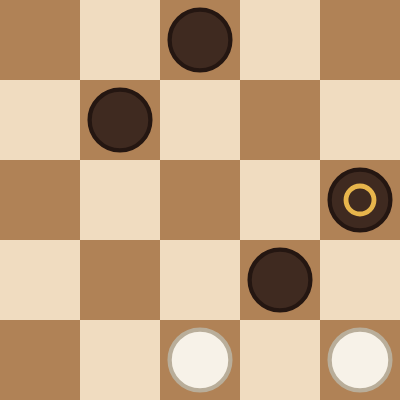
Checkers
english draughts
Checkers, played the way it is played in English: a man may jump a king, capture is compulsory but which capture is yours to choose, and the king steps one square. The same board as the Italian game and a different game on it. Five levels, from beginner to unforgiving.
Play CheckersHow to play
Touch: tap one of your pieces to see where it can go, then tap the square. If a piece will not move it is because a capture is compulsory somewhere on the board. Mouse: the same. Keyboard: N starts a new game, 1 to 5 choose the level.
The rules, in full
Checkers, or English draughts, is played on an eight-by-eight board, on the 32 squares of one colour. Each side starts with twelve men on its three nearest rows. You always have the light pieces at the bottom, and you always move first.
- A man moves one square diagonally forward, never backwards.
- A man captures forward only, jumping an enemy man or king next to it onto the empty square beyond.
- A king moves one square diagonally in any direction, and captures forwards or backwards. It does not slide across the board.
- Jumps chain. If the capturing piece can jump again from where it lands, it must, until nothing more can be taken. No piece can be jumped twice.
- A man that reaches the far row becomes a king. If it gets there by jumping, the move ends there, even if the new king could jump again.
- You lose when you cannot move, because your pieces are gone or all blocked.
Compulsory, but your choice
If any capture is available you must capture, and the game tells you so when you tap a piece that cannot move. What you are not forced into is a particular capture. When two or more are on the board, any of them is legal, even one that takes a single piece while another would take three. Once you start a jump, though, you finish the whole sequence. Tap a piece and only the squares it can legally reach are marked.
Strategy that actually helps
Set up a shot. Because captures are compulsory, you can give up a man on purpose so that the forced reply leaves an enemy piece open to a double jump. The computer is bound by the same rule, and has to take the bait when it is the only capture on offer.
Check what you are handing over. The same rule works against you. Before a move, look at every capture it gives your opponent and where the jumping piece would land.
Keep your back row as long as you can. A man on your home row stops an enemy man being crowned on that square.
Crown a king, but do not expect it to be safe. Here men can jump kings, so a king is stronger, not untouchable. Keep it close to your other pieces rather than sending it alone among the enemy's men.
Stay off the edges without a reason. A piece on the side cannot be jumped from that side, but it has half the diagonals of one in the middle.
The computer opponent
There are five levels: Beginner, Easy, Steady, Strong and Hard. Tap the level button to cycle through them, or press 1 to 5. The game starts on Steady and remembers your choice. Higher levels look further ahead, and the three lowest also pick at random among moves almost as good as the best, so they sometimes walk into a shot. The last move stays shaded on the board.
A game is drawn when forty moves go by on each side with no capture and no man moving: a simple rule for ending a game nobody can win, not the full tournament draw rules. There is no undo.
A little history
Games with jumping pieces on a chequered board have been played in Europe for centuries. The English form, with a short king and a free choice among captures, is called draughts in Britain and checkers in North America, and it has been written about in English since at least the eighteenth century. The Italian game uses the same board and the same short king, but there a man may never take a king and the largest capture is compulsory. To try it, play Dama Italiana.
Common questions
Is it free? Yes. It runs in your browser, with no signup and nothing to download.
Does it work on a phone? Yes. Tap a piece to see where it can go, then tap the square. It works in portrait and landscape.
Who moves first? You do, always, with the light pieces. Over a real board the darker side traditionally opens, so this is a convenience of the game rather than the tournament rule.
Is there a score? When a game ends it scores 10 points for every piece you captured and, if you won, 100 more plus 50 for each level.
More games
Also available in: Italiano