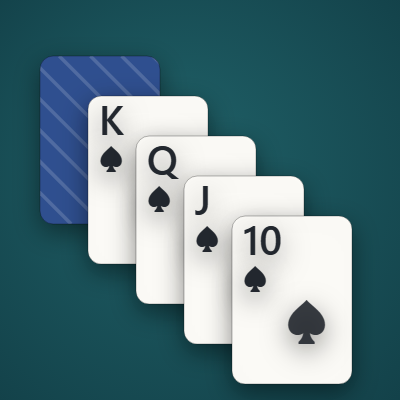
Spider
two-deck solitaire
Two packs, ten columns, and one rule that changes everything: any card may be placed on one a rank higher, but only a run of a single suit can be picked up again. Build a king down to an ace and it leaves the table. Eight of them wins.
Play SpiderHow to play
Touch: drag a run of one suit onto a card one rank higher, or tap a card to send it to the best column. Tap the deck to deal a card onto every column — it refuses while any column is empty. Mouse: the same. Keyboard: N deals a new game, Z undoes, H suggests a move, Space deals a row. It is played with one suit.
The rules, in full
Spider uses 104 cards. This version deals one suit, so every card is a spade: eight complete runs from Ace to King, shuffled together.
Fifty-four cards go into ten columns. The first four get six cards, the other six get five, and only the bottom card of each is face up. The remaining 50 wait in the deck, enough for five more rows.
The goal is eight complete sequences, each running from King down to Ace in one suit. When the eighth is finished, the deal is solved.
- Placing is generous. Any card can go on a card one rank higher, whatever its suit: a 6 on any 7.
- Lifting is strict. You can only pick up a run that descends by one and shares a single suit.
- An empty column takes anything, a single card or a whole run.
- The deck deals a whole row. One tap puts a face-up card on each of the ten columns. It refuses while any column is empty, and the game tells you why.
- A finished sequence leaves by itself. The moment a column ends in a complete King-to-Ace run, those 13 cards move to the row at the top.
- A face-down card turns over by itself as soon as nothing covers it.
There are no foundations to feed card by card and no free cells. Cards leave the table only as complete sequences.
Scoring
- 100 points for every completed sequence
- 5 points for every hidden card you turn over, including one uncovered when a sequence leaves
Ordinary moves and dealing a row neither add nor cost anything. Your best score is kept in this browser when you solve a deal.
Strategy that actually helps
Build long, tidy runs. With a single suit, any descending run can be lifted. A run from King to 7 is one object you can move, and it is already half of a finished sequence.
Go after the face-down cards. Most of the deal starts hidden. A move that turns a card over gives you a new option and 5 points; a move that only shuffles face-up cards gives you neither.
Treat an empty column as your most valuable space. It accepts any card, so it lets you split a run, reorder a column or dig out a buried card. Do not fill it with a lone card you have no plan for.
Deal only when you are out of useful moves. Each deal covers every column and the runs you built. Move everything you can first, and remember the deck will not deal until every column holds at least one card.
Watch the Kings. Nothing goes on a King, and a King can only move into an empty column. A King sitting on face-down cards blocks them until a column opens up.
Undo and hints
Undo steps back one move at a time, up to 400 steps, including a deal from the deck and a sequence that left the table. The hint button (H) highlights the move the game rates best. It never suggests dealing a row: that choice stays with you.
Spider needs no automatic finish, because a sequence leaves the moment it is complete. If the game says there are no moves left, undo a few steps and try another line, or start a new deal.
A little history
Spider is a two-pack patience, usually counted among the harder classic solitaires. It is often said to have been a favourite of Franklin D. Roosevelt, though the story is hard to confirm. Many people met it on a computer: Microsoft included it in the Plus! add-on for Windows 98, and later versions of Windows shipped it as standard. If you would rather play with one pack and alternating colours, try Klondike.
Common questions
Is it free? Yes. It runs in your browser, with no signup and nothing to download.
Does it work on a phone? Yes. Drag a run with a finger, or tap a card to send it to the best column, and tap the deck to deal. It works in portrait and landscape.
How many suits does it use? One. Every card is a spade, so every descending run can be picked up.
Can I install it? Yes. Bananai can be installed as an app from the browser, and a game you have already opened usually keeps working when the connection drops.
More games
Also available in: Italiano