Scopa
Italian card game
Scopa for two, against the computer, first to 11 points. Take the matching card or the cards that add up to it, sweep the table for a scopa, and at the end of each hand count the cards, the coins, the settebello and the primiera. With napola if you play it, Neapolitan or Piacentine cards, and three levels.
Play ScopaHow to play
Touch: tap a card in your hand to play it. If it can take in more than one way, tap the table cards you want to take. Mouse: the same. Keyboard: 1 to 3 choose a card; if it can take in more than one way, the arrows change the capture and Enter confirms it. N starts a new match, L changes the level, D changes the cards.
The rules, in full
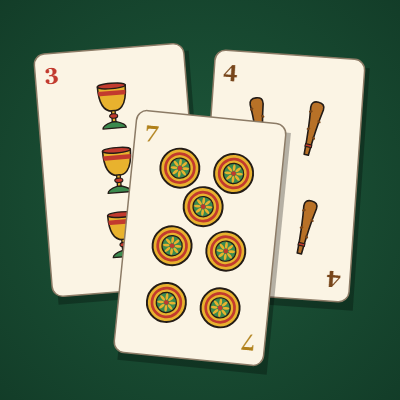
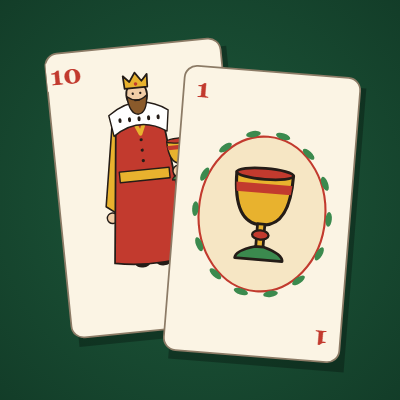
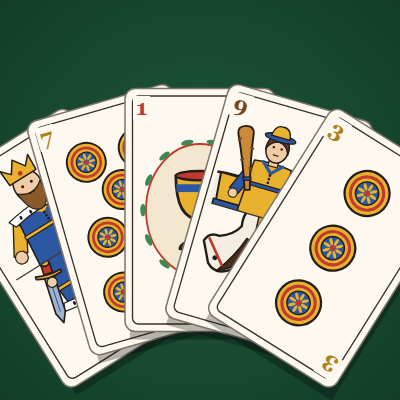
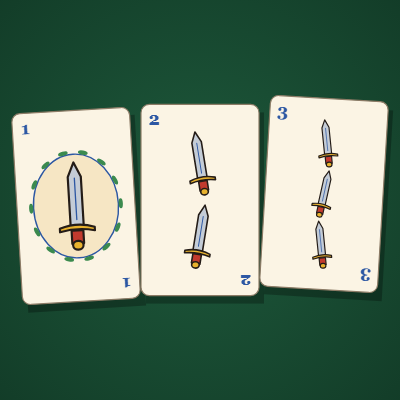
Scopa is played with a 40-card Italian pack: cups, coins, swords and batons, each with an Ace, the cards from 2 to 7, the Jack (8), the Knight (9) and the King (10). Here it is played by two, you against the computer, and a match goes to 11 points.
Each player gets three cards and four go face up on the table. You take turns playing one card:
- A card takes the table card of the same value, or several cards that add up to its value. A Knight, worth 9, takes a 9, or a 5 and a 4, or a 6, a 2 and an Ace.
- If a card of the same value is on the table, you must take that one rather than a sum. A 5 with a 5, a 3 and a 2 on the table takes the 5, not the 3 and the 2.
- If you can take, you must. Only a card that takes nothing stays on the table.
- Taking every card on the table is a scopa, a sweep, worth a point. It does not count with the last card of the hand.
- When the hands run out three more are dealt to each player while the deck lasts. At the end, whatever is left on the table goes to whoever captured last.
If three or four Kings come up on the table at the start, the cards are shuffled and dealt again.
How the points are counted
At the end of a hand each player looks at the cards they took:
| Point | Who scores it |
|---|---|
| Cards | whoever has more cards (20 all scores for nobody) |
| Coins | whoever has more coins (5 all scores for nobody) |
| Settebello | whoever has the 7 of coins |
| Primiera | whoever has the higher primiera |
| Sweeps | one point for each scopa |
For the primiera, take your best card in each suit and add up their values: a 7 is worth 21, a 6 18, an Ace 16, a 5 15, a 4 14, a 3 13, a 2 12 and a court card 10. A player with no card in some suit has no primiera at all. That is why the Sevens matter so much: they win the primiera, and the 7 of coins is the settebello as well.
The game shows the count line by line at the end of every hand, with the match total. The first to 11 wins; if both pass 11 the higher score wins, and a tie means another hand.
Napola
Napola is a rule played mostly in the south of Italy, and here it has its own Napola button. Whoever captures the Ace, the 2 and the 3 of coins scores napola, worth 3 points, plus one for each further coin that continues the run: with the 4 as well it is 4 points, with the 4 and the 5 it is 5, and so on.
Turning napola on or off starts a new match, because it changes the count.
Against the computer: three levels
- Easy takes what it sees, often at random, and never looks at what it leaves on the table.
- Normal values captures the way a player does — the settebello, the Sevens, the coins, a sweep — and before putting a card down it asks whether that leaves you a scopa.
- Hard keeps track of every card that has gone, imagines the ones it cannot see, and plays each of its moves out to the end of the hand, keeping the one that does best.
The computer never sees your cards or the deck. Changing level starts a new match.
Strategy that actually helps
Do not leave a sweep. Before putting a card down, add up what stays on the table. If it comes to 10 or less, your opponent may take the lot with one card. A single card left on the table is an invitation.
The settebello is a point on its own. If it is on the table and you can take it, you almost always should. If it is in your hand, do not put it down where it can be taken.
Sevens win the primiera. Every 7 you take brings you closer to it and takes away your opponent's best card. Sixes and Aces come next.
Count the coins. Six are enough for the point. Halfway through a hand you already know whether you can get there or should let them go.
Keep track of the Kings. There are four in the pack. Once three have gone, a King on the table is safe: nobody can take it.
Controls
- Touch or mouse: tap a card in your hand to play it. If it can take in more than one way, the table cards it can take light up: tap the ones you want.
- Keyboard: 1 to 3 choose a card; if it can take in more than one way, the arrows change the capture and Enter confirms it. N starts a new match, L changes the level, D switches the cards between Neapolitan and Piacentine.
A little history
Scopa is probably the most played card game in Italy, north to south, and its name says it all: scopa means broom, and you sweep the cards off the table. It is also where scopone comes from, the four-player game in pairs; if you want to try it, there is Scopone Scientifico. If you would rather play a trick-taking game, try Briscola.
Common questions
Is it free? Yes. It runs in your browser, with no signup and nothing to download.
Can I play Scopa against the computer? Yes, that is how this version works: you against the computer, at three levels.
How many points do you need to win at Scopa? Here, 11. Some places play to 21; the rules are the same, only the match is longer.
What is the settebello? The 7 of coins. Whoever takes it scores a point at the end of the hand, whatever else they hold.
How is the primiera worked out? Take your best card in each suit among your captures and add them up: 7 = 21, 6 = 18, Ace = 16, 5 = 15, 4 = 14, 3 = 13, 2 = 12, court cards = 10. The higher total wins.
If I can capture, may I choose not to? No. A card that can take must take, and if a card of the same value is on the table it must take that one.
Does it work on a phone? Yes. Tap a card to play it; when there is more than one possible capture, tap the table cards you want.
More games
Also available in: Italiano